
When a robot enters a new room, it does not see all the information in the room. Much of what its task depends on is out of view. Is the item in that drawer? Is the cup empty? Did something move after the robot left the room?
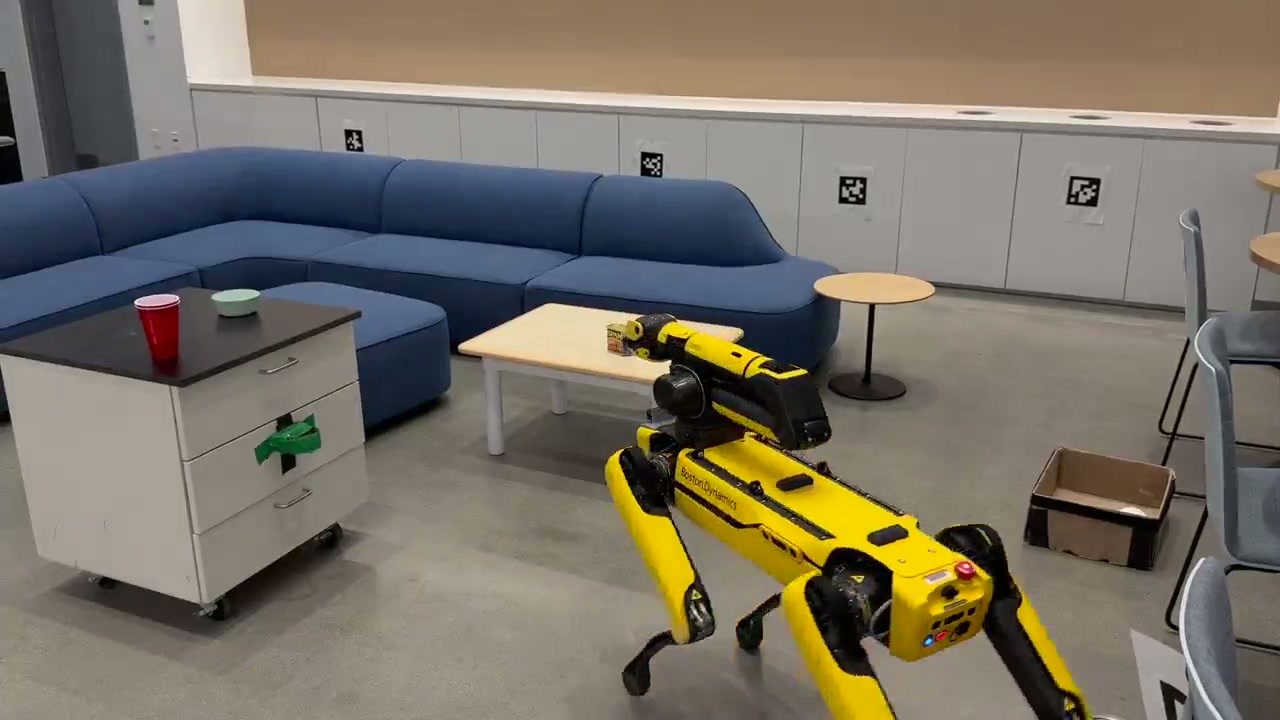
When the robot cannot see something
Standard planning methods typically assume complete knowledge of the environment, so a planner has to decide what a closed drawer means. If it treats “not seen” as “not there”, a closed drawer becomes an empty drawer, and the robot gives up on a search it could have finished, or reports something as absent when it never looked.
So the question we keep coming back to is simple: when a robot cannot see something, what should it write down?
True, false, or unknown
In Seeing is Believing, the robot keeps a small set of facts about the objects that matter for the task, such as “the item is in drawer 2” or “the cup is empty”. Each fact is true, false, or unknown. Unknown is not the same as false.
A vision-language model fills in these facts from what the camera shows. A classical planner then decides what to do next, including when it is worth opening a drawer or looking from another angle. When what the robot sees contradicts what it expected, it updates the facts and plans again.
The core design, in more detail
Each task predicate is stored as a pair of known facts. For a drawer d1, emptiness becomes KnownEmpty(d1) and KnownFull(d1). If neither holds, emptiness is unknown. This symbolic belief is what the planner reads; it never keeps a probability distribution over world states.
- Perception. An open-vocabulary detector points to the objects in view, and segmentation plus depth gives their positions. For each detected object, including ones the robot has just found, the VLM answers yes, no, or unknown for the relevant predicates, in one batched query across the camera views.
- Looking as an action. An information-gathering action, such as observing whether a cup is empty, applies only while that fact is unknown. Its outcome is not known in advance, so it is compiled into two deterministic actions, one for each outcome (all-outcomes determinization). The classical planner picks the outcome that helps reach the goal; if the real observation differs, the robot replans.
- Goal translation. The VLM also turns the instruction into a goal over these predicates, so a goal like “remove every empty cup” can depend on facts that start unknown.
- Execution monitoring. After each action the robot observes again. If the result contradicts the outcome the plan assumed, it updates the belief and replans from there.
The abstraction: a symbolic belief
Each predicate is stored as two known-predicates (K-fluents).
KP | K¬P | Belief about Empty(drawer) |
|---|---|---|
| 1 | 0 | known true |
| 0 | 1 | known false |
| 0 | 0 | unknown |
Unknown facts decide when to look
If the goal depends on a fact that is still unknown, the plan first looks: open the drawer, or view the cup from above. The robot plans as if the look gives the answer it needs, and replans if it does not.
The loop: observe, update, plan, execute
- Observe Images and sensor inputs from the robot.
- Update A VLM points to objects and evaluates predicates. Only answers it can give with confidence change the belief; known facts stay known.
- Plan A symbolic planner (Fast Downward) plans over the belief, toward a goal translated from text by a language model.
- Execute Run the first action as a robot skill.
If an observation differs from the outcome the plan assumed, replan from the updated belief.

On a real robot
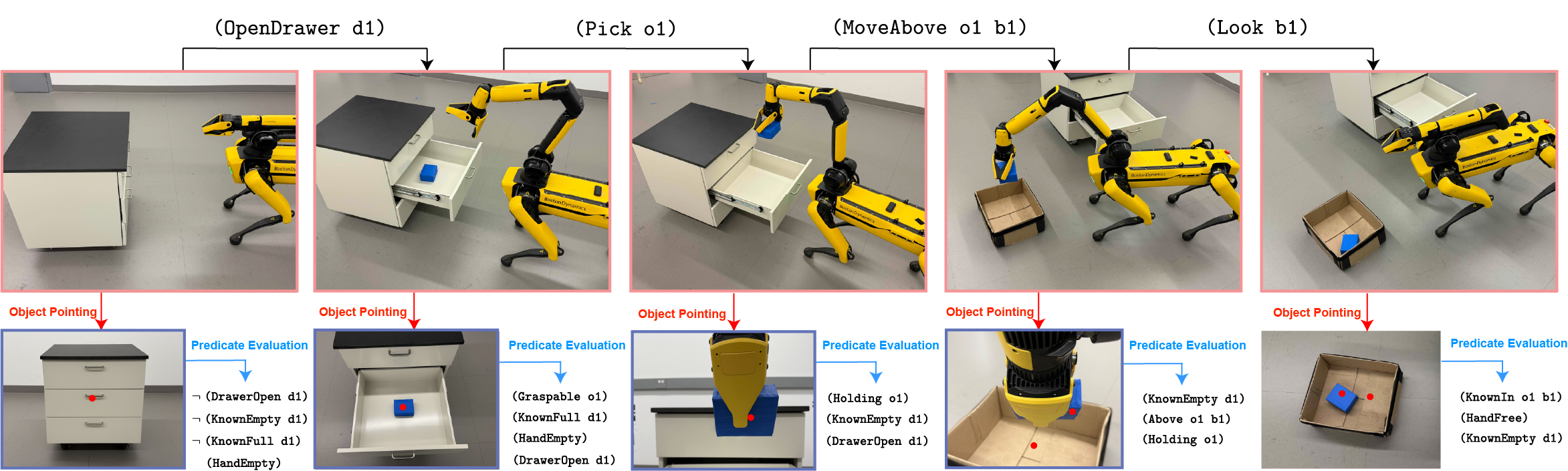
The robot opens the closed drawer because emptiness is unknown, then acts on what it finds.
Task: put any object in the drawer into the paper bin. Top: the actions. Bottom: object pointing and the
predicates the VLM evaluated after each action. Before the drawer opens, KnownEmpty(d1) and KnownFull(d1)
are both false, so emptiness is unknown and the plan starts with opening the drawer. Fig. 2 of the paper; tap
the image for full size.
What changes when a model may say “unknown”?
What happens when a model has to answer yes or no about a drawer it cannot see? And what changes when it may answer “unknown” instead?
Explicit facts can be checked
Because every fact the robot holds is written down, each one can be checked. In simulation we know what is really inside every drawer, so we can tell when the robot reports a hidden fact as known, or reads a visible one wrong.
The same check works as a signal for an agent: it can verify each step, or give an extra reward for finding out what the task needs.
Every state of knowledge is a node, so progress can be checked step by step. The belief-space graph for the two-cup task, keeping the beliefs on every shortest plan. Each node is a symbolic belief (which facts are known true, known false or unknown); each edge is an action, and an observation can branch into the outcomes it may return. A trajectory can be scored against this graph: whether each step moves toward a goal belief, and which unknown facts it resolved. Drag to pan, scroll to zoom.
Results
Cup Pick-Place
fully observable
Path efficiency (SPL, 1 = optimal): ours 1.00; best other 0.69
Drawer Cleaning
contents hidden in a drawer
Path efficiency (SPL, 1 = optimal): ours 0.32; best other 0.04
Sort Weight
boxes must be weighed
Path efficiency (SPL, 1 = optimal): ours 0.46; best other 0.00

Sort Weight: the boxes are sealed, so the only way to know which one is empty is to weigh it. Six of the states the agent passes through; each state is a real photo. The shortest solution takes 14 actions. Fig. 4 of the paper; tap the image for full size.
Model, determinization, and assumptions
Turn partial observability into repeated classical planning
The method has one modeling step and one online loop. Keeping these separate makes the role of three-valued predicates precise.
- Predicates and goal
Empty(?c),Inside(?x, ?c)- World-changing operators
Open,Pick,Place- Information operators
ObserveEmpty(?c)
P = ? when neither K(P) nor K(not P) is stored ObserveEmpty(drawer) ObserveEmpty+ assume Empty(drawer) = T ObserveEmpty- assume Empty(drawer) = F The planner may choose the useful outcome optimistically. Execution does not: the observation determines which fact is written to memory.
- 1PlanCall a classical planner on the determinized model.
- 2ExecuteRun the next symbolic action as a robot skill.
- 3Observe and updateUse perception to update only the relevant predicates.
- 4Check and replanIf reality differs from the assumed outcome, discard the suffix and plan again.
Planning graphs for each task
These are the belief-space graphs the planner works with. Each node is a belief; an observation can come back either way, so the graph branches there.
- Two cups: every shortest plan (also on the project page).
- Cup emptiness: shortest plan.
- Two cups: the belief policy, one branch per observation outcome.
- Drawer cleaning: transition graph.
- Two-cup pick and place: transition graph.
- Sort by weight: transition graph.
- Sort by weight: the belief policy.
Questions we are still asking
- Which tasks actually need a robot to keep track of what it has not seen, and which can be solved by a simple search rule?
- As models get better, which perception mistakes go away, and which stay?
- Can we predict how a whole robot system will do from how each of its parts does?
Paper: arXiv. Project page: Seeing is Believing.