Planning to Perceive with Foundation Models and Act Under Unknowns
Linfeng Zhao 1,2
Willie McClinton 3,*
Aidan Curtis 3,*
Nishanth Kumar 3
Tom Silver 4
Leslie Pack Kaelbling 3
Lawson L. S. Wong 2
1
2
3
4
*Equal contribution
The problem
Task-level planning is critical to long-horizon mobile manipulation.
Standard planning methods typically assume complete knowledge of the environment.
A robot entering a new room does not see everything: it must discover, perceive, and interact with objects while resolving uncertainties.
Robots must plan not only manipulation actions, but also information-gathering actions.
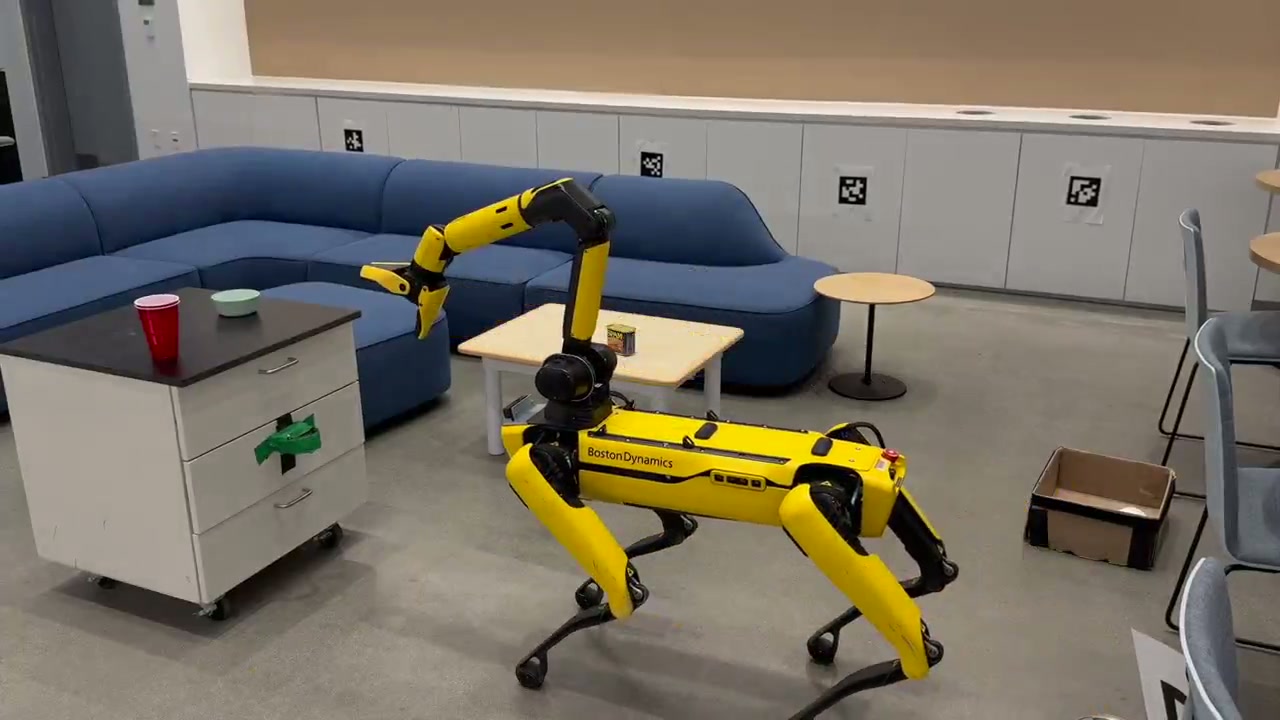
Entering a new room: the cup and the bowl are visible, but not what is inside the closed drawers.
Frame from the Drawer Cleaning video below.
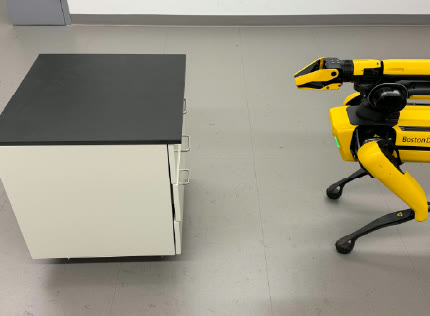
What the camera sees. A closed drawer. Is it empty? The image cannot tell.
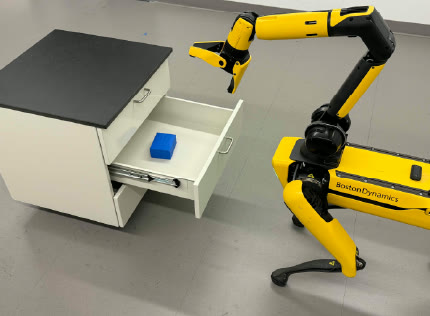
What is in it. A blue block, found only after the robot opens the drawer.
Illustration
Assume the hidden part is known
Treat the drawer as empty
Plan: nothing to remove
Report the task done
✕ The block stays in the drawer.
Keep Empty(drawer) unknown
Plan to open the drawer and look
See the block; update the belief
Replan: pick it, place it in the bin
✓ The goal is reached and known to be reached.
Much of what a task depends on is not in the image. Left and middle: real frames of a Spot robot
from the paper's drawer-cleaning example (Fig. 2). Right: an illustration of the two choices, not a
measured result. Measured results are on the blog.
Core design
Each fact about an object is known true, known false, or unknown. Unknown is not false: a closed drawer is not an empty drawer.
When the goal depends on an unknown fact, the planner adds an action to look, such as opening the drawer.
Vision-language models check facts in the camera images and translate the goal from text.
Illustration of the method
The abstraction: a symbolic belief
Each predicate is stored as two known-predicates (K-fluents).
KP
K¬P
Belief about Empty(drawer)
1
0
known true
0
1
known false
0
0
unknown
Unknown facts decide when to look
If the goal depends on a fact that is still unknown, the plan
first looks: open the drawer, or view the cup from above. The robot plans as if the look gives the answer
it needs, and replans if it does not.
The loop: observe, update, plan, execute
Observe Images and sensor inputs from the robot.
Update A VLM points to objects and evaluates predicates. Only answers it can give with confidence change the belief; known facts stay known.
Plan A symbolic planner (Fast Downward) plans over the belief, toward a goal translated from text by a language model.
Execute Run the first action as a robot skill.
↺ If an observation differs from the outcome the plan assumed, replan from the updated belief.
Unknown facts are tracked explicitly, and they decide when the robot looks before it acts.
Left: how one predicate holds three values, and how unknown facts lead to looking. Right: the runtime loop (Algorithm 1 in the paper).
Interactive · generated by the planner
Planning to look: an observation can come back either way, and the plan branches on it.
The belief-space graph for the two-cup task, keeping every shortest plan. Because every state of knowledge
is explicit, the same graph can check an agent’s progress step by step and give it an extra signal, such as
a reward, for what it has found out. Drag to pan, scroll to zoom.
Connection to the major directions
POMDPs: plan in the space of beliefs (Kaelbling et al., 1998). We make the belief symbolic and object-centric.
Belief-space task and motion planning: mix acting and looking, plan online, replan (2012, 2013). Our belief update comes from vision-language models.
Classical replanning with knowledge fluents: known-true and known-false facts let a classical planner decide when to look (Bonet and Geffner, 2011).
Agentic robots and hierarchical systems: models ground instructions in skills (SayCan), write robot programs (Code as Policies) and use feedback (Inner Monologue). Ours is a hierarchy too: models estimate facts, a planner decides, skills act.
On a real Spot robot
Real robot · 4× speed
Empty Cup Removal
The robot cannot tell from the front whether a cup is empty. It looks from above, finds the yellow
cup filled, replans, and moves the empty red cup to the bin. Played at 4×; model wait time is cut;
the on-screen labels were added in editing.
Real robot · 4× speed
Drawer Cleaning
The robot opens the drawer, discovers the objects inside, and removes them. Played at 4×.
Each video is one demonstration of the system, not a success-rate measurement.
Cite this work
Linfeng Zhao, Willie McClinton*, Aidan Curtis*, Nishanth Kumar, Tom Silver, Leslie Pack Kaelbling, and Lawson L. S. Wong. Seeing is Believing: Belief-Space Planning with Foundation Models as Uncertainty Estimators. arXiv:2504.03245, 2025.
title = {Seeing is Believing: Belief-Space Planning with Foundation Models as Uncertainty Estimators},
author = {Linfeng Zhao and Willie McClinton and Aidan Curtis and Nishanth Kumar and Tom Silver and Leslie Pack Kaelbling and Lawson L. S. Wong},
year = {2025},
eprint = {2504.03245},
archivePrefix = {arXiv},
primaryClass = {cs.AI},
url = {https://arxiv.org/abs/2504.03245}
}
Acknowledgments
We thank Jenny Barry, Tomás Lozano-Pérez, Will Shen, Aditya Agarwal, Ben Zandonati, Xiaolin Fang, Jiayuan Mao, and all members of the MIT Learning and Intelligent Systems (LIS) group and the Watch, Understand, Do team at the RAI Institute (formerly the Boston Dynamics AI Institute) for helpful discussions and support.