ICLR 2023
Implicit Differentiable Planning
Scaling up and Stabilizing Differentiable Planning with Implicit Differentiation
Motivation
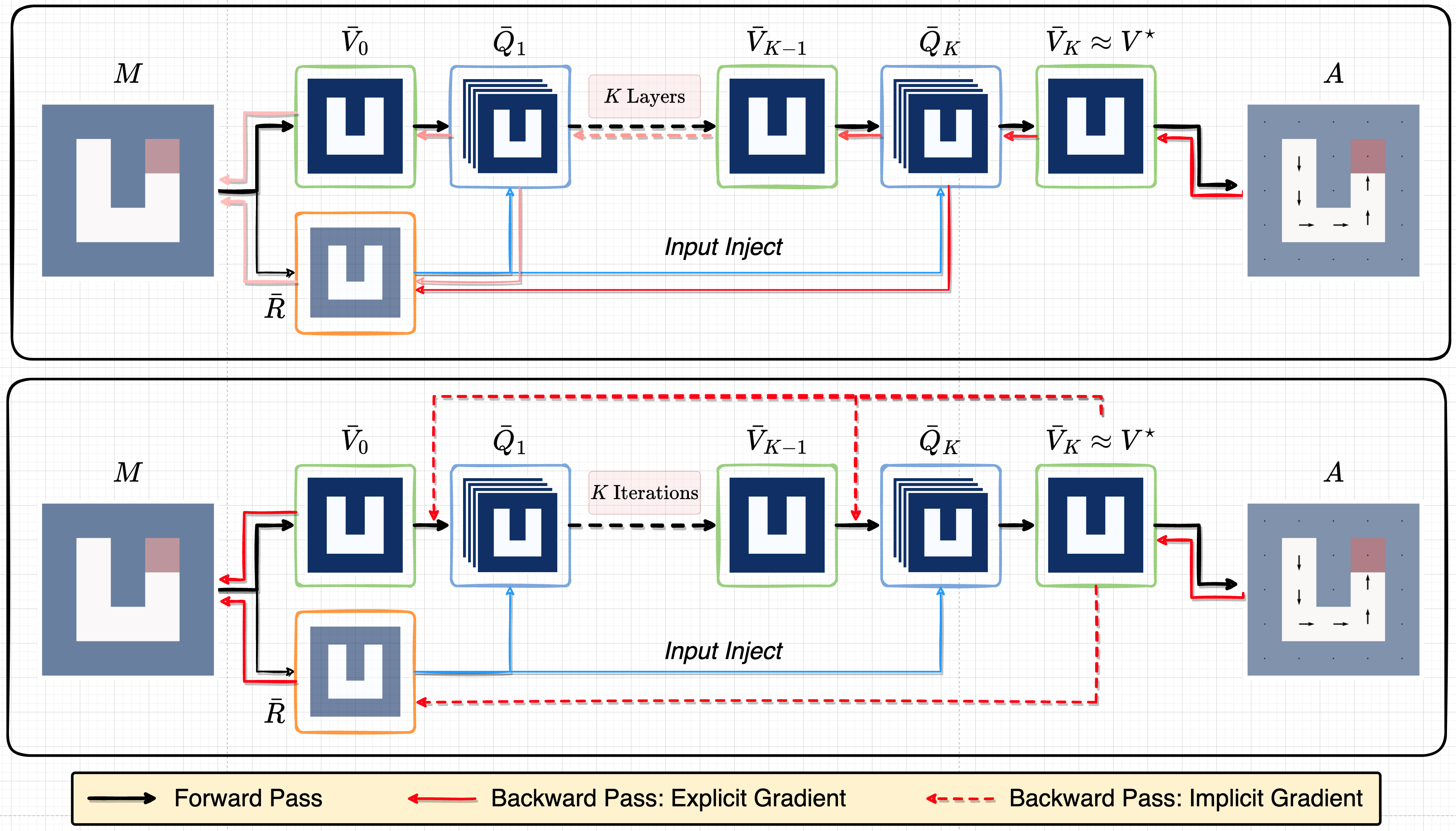
- VIN-based planners are trained end to end by differentiating through the planning process.
- Algorithmic differentiation couples the backward pass to every forward planning iteration.
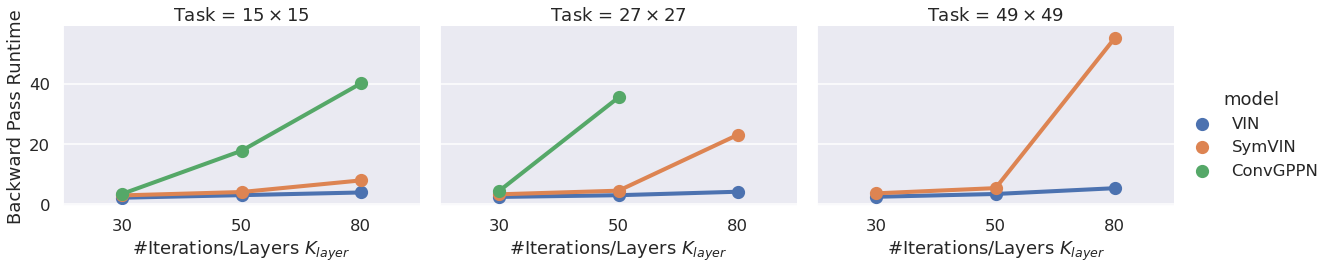
- Longer planning horizons increase backward runtime and memory use, and deep unrolls can become unstable.
Implicit Differentiation
- Repeated application of the Bellman operator produces an estimated fixed point, v*.
- Differentiate through the fixed-point equation instead of the forward iteration layers.
- The forward and backward passes use separate iteration budgets.
- The forward pass must still solve the equilibrium accurately; with too few iterations, algorithmic differentiation can be preferable.
v* = f(v*, r, theta)
dv*/dx = (I - df/dv*)^-1 df/dx
Evaluation Environments
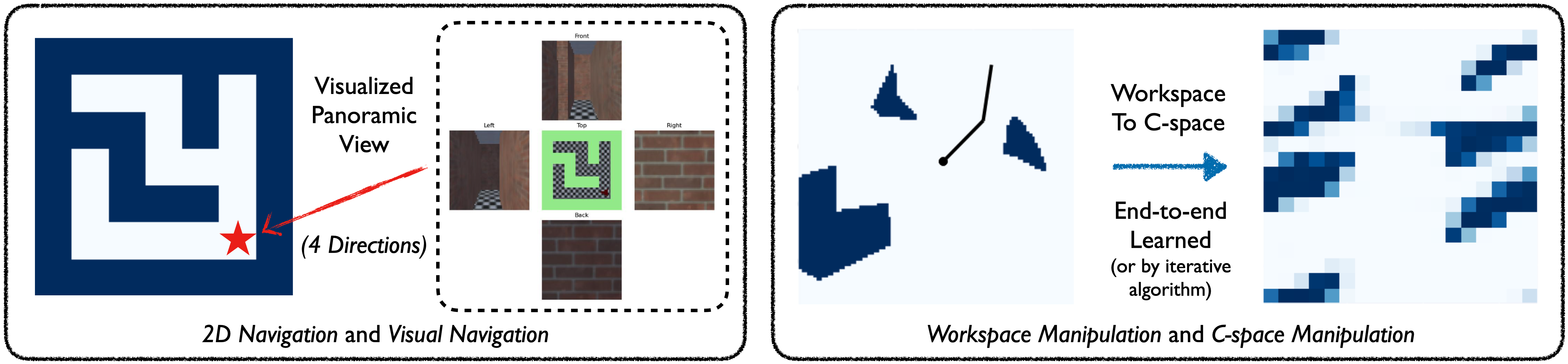
- 2D maze navigation with a given grid map
- Visual maze navigation with a learned map
- 2-DOF manipulation in configuration space
- 2-DOF manipulation in workspace with a learned map
Runtime and Memory
- Algorithmic differentiable planners have backward runtime and memory use that grow with the number of unrolled layers.
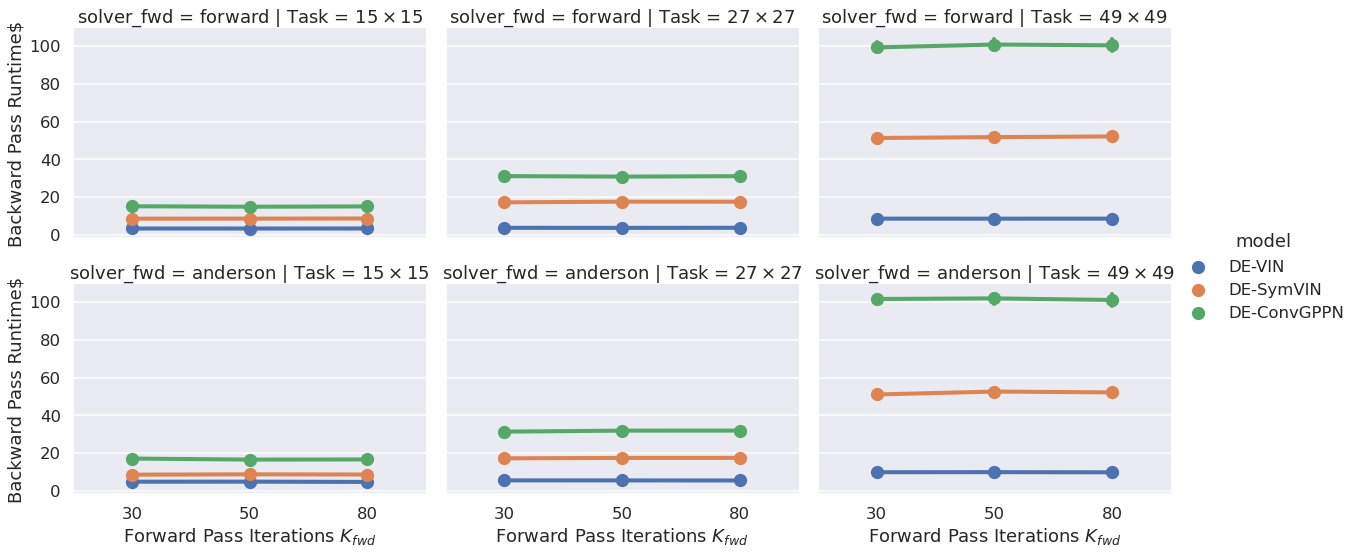
- Implicit differentiable planners have backward runtime independent of the number of forward iterations.
- Forward runtime remains comparable, while memory use is lower and larger models continue to run when explicit planners exceed the 11 GB limit.
- On 2D navigation, implicit planners converge stably at iteration counts where some algorithmic planners fail.
Generalization to Larger Maps
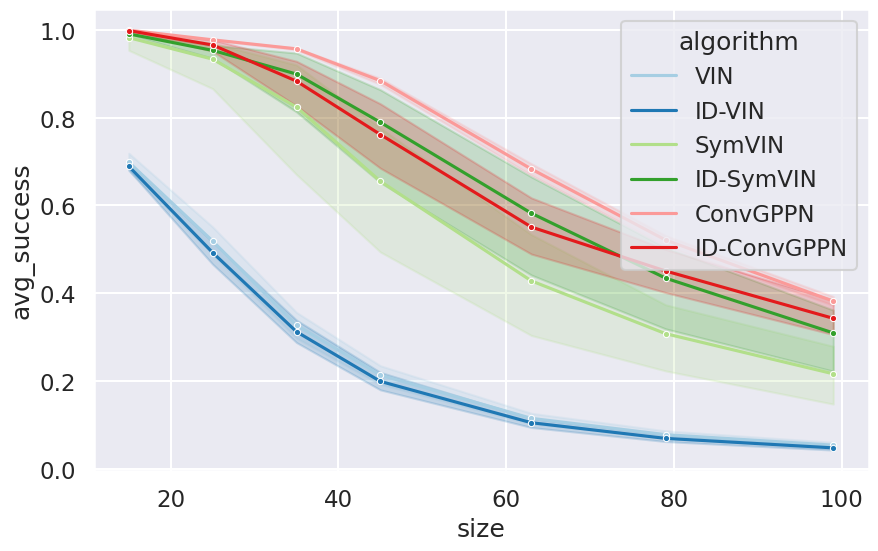
- Models are trained on 15 x 15 maps and evaluated on unseen maps up to 99 x 99.
- ID-SymVIN outperforms SymVIN; VIN and ID-VIN perform similarly; ID-ConvGPPN trails ConvGPPN.
- The main benefit is training scalability and convergence stability, not a universal improvement in forward generalization.
Publication
Linfeng Zhao, Huazhe Xu, and Lawson L.S. Wong. International Conference on Learning Representations, 2023.